
Kosovo’s energy sector is undergoing a significant transformation as the country seeks to strengthen energy security, diversify energy sources, and advance its commitments under the Energy Community Treaty, Green Agenda for the Western Balkans, and European Union’s climate and energy objectives. For decades, electricity generation in Kosovo has relied predominantly on lignite, making the country one of the most coal-dependent energy systems in Europe. While this has historically ensured domestic electricity production, it has also contributed to high greenhouse gas emissions, air pollution, and increasing pressure to accelerate the transition towards cleaner and more sustainable energy sources.
Renewable energy represents a central pillar of this transition. Recent policy developments, including the adoption of Kosovo’s Energy Strategy 2022–2031 and the Law No. 08/L-258 on the Promotion of the Use of Renewable Energy Sources, have established ambitious objectives for increasing renewable energy generation, improving energy efficiency, and encouraging greater participation by households, businesses, and local communities. At the same time, various public support mechanisms, including subsidy programmes for energy efficiency and residential solar photovoltaic systems, have created new opportunities for citizens to invest in renewable energy technologies.
However, achieving these policy objectives depends not only on the availability of financial incentives or legal frameworks, but also on the ability and willingness of citizens to participate in the transition. Access to reliable information, understanding of administrative procedures, confidence in public institutions, and perceptions of affordability all influence whether households decide to invest in renewable energy technologies. Even where support programmes exist, complex administrative procedures, limited awareness, or uncertainty regarding eligibility and application processes may discourage participation.
International experience demonstrates that successful energy transitions require active public engagement alongside institutional reforms. Citizens are not merely beneficiaries of renewable energy policies but important actors whose decisions collectively shape energy demand, investment patterns, and public acceptance of climate policies. Understanding public perceptions, experiences, and barriers is therefore essential for designing effective policies that respond to citizens’ needs and increase the uptake of renewable energy solutions.
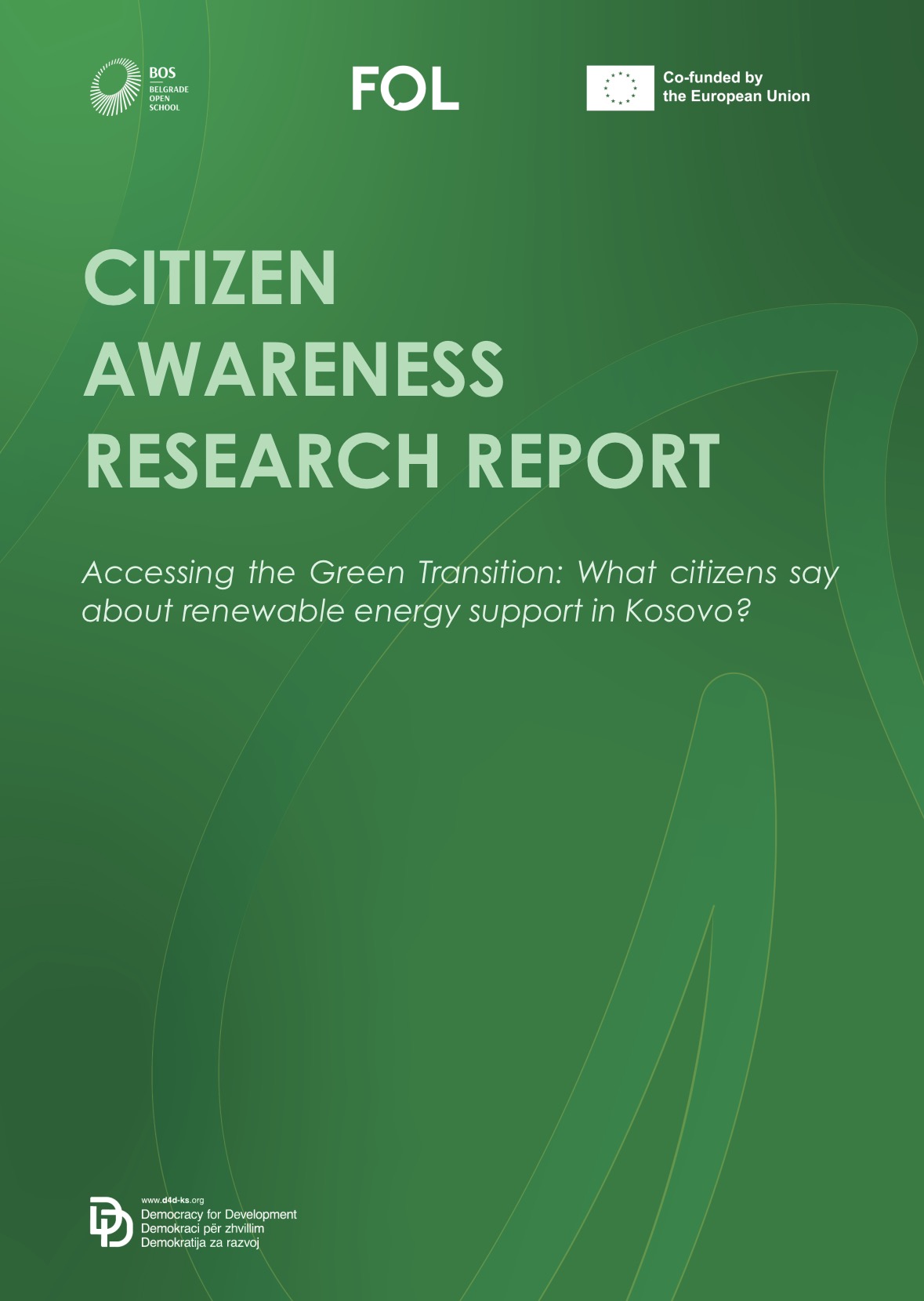
Against this background, this report presents findings from an omnibus survey conducted in Kosovo in March 2026. The study examines citizens’ awareness of renewable energy programmes, their experiences with administrative procedures, access to information, perceptions of institutional performance, and barriers to investing in renewable energy technologies. It also explores how these perceptions vary across different population groups, providing insights into demographic differences that may require targeted policy responses.
Rather than assessing the technical performance of renewable energy systems, the report focuses on the human dimension of the energy transition. It seeks to understand how citizens perceive existing opportunities, what challenges they encounter, and what measures they believe would facilitate wider adoption of renewable energy. By combining nationwide survey data with analysis of citizens’ experiences and attitudes, the report aims to contribute evidence that can inform future policy development, institutional improvements, and public communication efforts in Kosovo’s renewable energy sector.
The report is structured as follows. Following this introduction, chapter 3 describes the survey methodology and respondent profile. The subsequent chapters analyze citizens’ experience with renewable energy programmes, awareness and access to information, administrative and institutional barriers, trust in relevant institutions, and perceived barriers to investment. The report concludes by summarizing the key findings and presenting recommendations aimed at strengthening citizen participation in Kosovo’s renewable energy transition.